
How to Search New Mexico Criminal Dockets
New Mexico Case Lookup is the free public starting point for criminal case information. It covers District, Magistrate, Metropolitan, Municipal, and appellate courts. Municipal coverage is thin, and no filed document images appear. A statewide result helps you pin down the court and case number. The clerk of that court keeps the official register and case papers. Paperwork can leave the route unclear. The New Mexico Courts district finder helps you identify the court location.
Use the exact case number if you have it. Otherwise search a party name. The live form supports court, location, category, and year filters. Those dropdowns are dynamic, and name-search behavior is not fully documented. For a fuller picture of portal coverage and search limits, see the statewide case search. Criminal docket entries stay with the court that opened the case.
- Choose the court type and location that match the notice or other case information.
- Enter the case number exactly as printed, or search by a party name and narrow the result with available fields.
- Open the likely match and confirm the New Mexico court, case category, filing year, and status before relying on it.
- Read the register for filings and settings, then check the current court calendar for a live hearing date.
- For the full criminal case file or a certified paper, use the New Mexico county directory to reach the originating court's clerk.
New Mexico Case Lookup for Criminal Dockets
The public form splits court and case filters from name searches. No single required-field rule applies across the judiciary. The dropdown choices shift with the court you pick. You can narrow a New Mexico criminal search by category and year. Confirm each location option on the live portal. Do not infer it from a statewide court roster.
| Search field | Type | Required | Criminal note |
|---|---|---|---|
| Party name | Text | Not specified | Name search is documented; wildcard behavior is not confirmed. |
| Driver license number and state | Text and dropdown | Not specified | Legacy help lists these inputs; they are not a driver abstract. |
| Date of birth or year only | Date or year | Not specified | Search guidance lists these variants; personal details are not displayed in public results. |
| Court type and location | Dropdowns | Not specified | Choose the court that opened the case; choices populate dynamically. |
| Case category | Dropdown | Not specified | CR is an example category, not an event code. |
| Filing date or year | Date or text | Not specified | Pre-1997 records require a separate Judiciary request. |
| Case number | Segmented text | Not specified | Keep the full court-issued format and its separators. |
The state's criminal docket search starts at the New Mexico Case Lookup search screen.
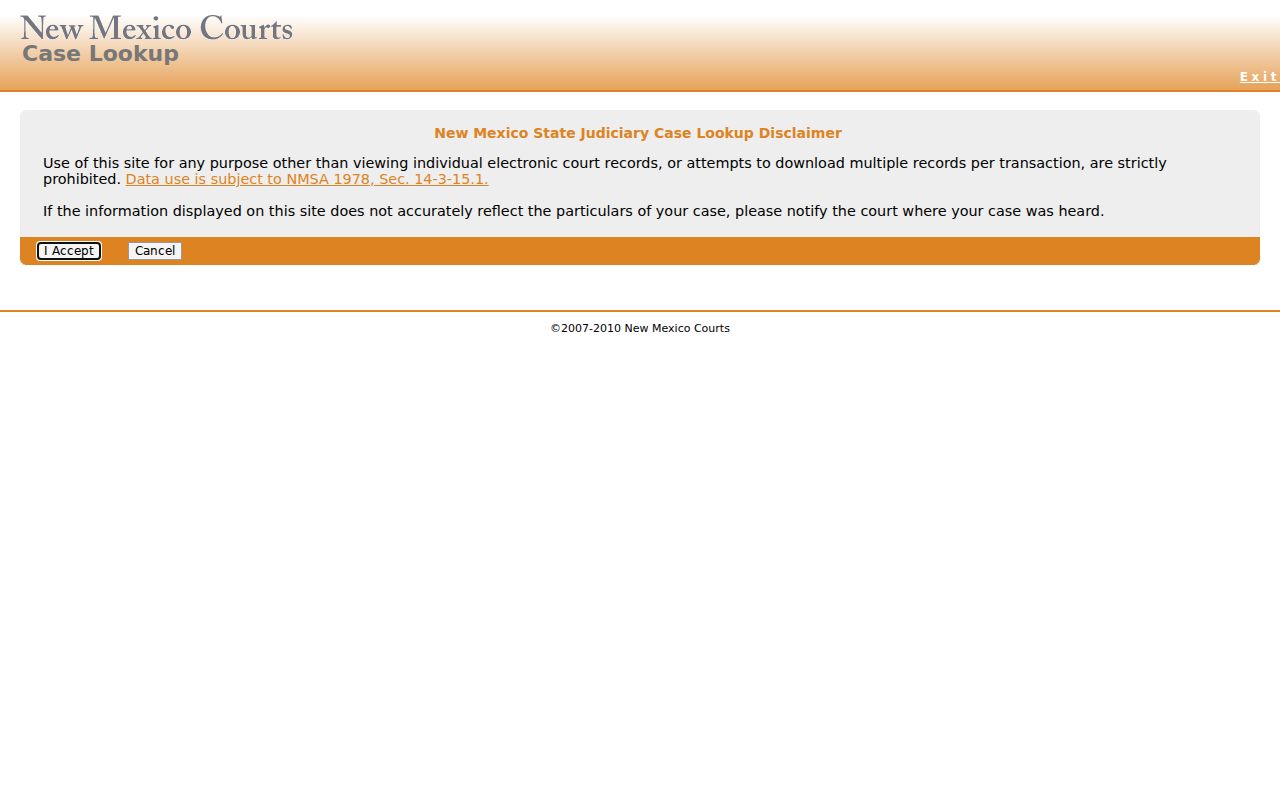
The official page shows the search interface itself, not a sample person's New Mexico docket. No anonymous public demo docket exists. Exact result fields and event order should not be guessed.
Registered re:SearchNM provides Odyssey case information and document access by user profile. Judiciary help also points to the secured SOPA access service when re:SearchNM has issues. Those tiers differ from no-login Case Lookup. eFile & Serve is for authorized filing and service. It is not for public docket searching.
What a Criminal Docket Shows
New Mexico Rule 1-079 counts a register of actions and docket entries as court records. Public Case Lookup can show the court, case number, category, filing year, status, party role, and register activity where those fields are exposed. The live display varies, though. A field in one court's system is not guaranteed in every New Mexico criminal result.
| Case number | A New Mexico court-assigned identifier. A representative criminal format is D-202-CR-2024-12345; exact segmentation varies by system era and court. |
|---|---|
| Charge and filings | Charging entries may identify an instrument or charge, but the public result does not guarantee a full charge block or document image. |
| Settings | Entries may identify an initial appearance, arraignment, pretrial conference, motion hearing, plea, trial, or sentencing setting. Labels vary locally. |
| Plea and result | A plea, dismissal, judgment, or sentence may appear in the register. New Mexico publishes no single public glossary for disposition codes. |
| Orders and documents | A register entry can point to a filing without displaying the signed order or paper itself. |
Treat the register as a chronology. It does not replace the charging paper, the signed judgment, or the current notice. Bond terms, warrant status, attorney names, financial balances, and related-case links are not guaranteed public Case Lookup fields. If a New Mexico criminal docket detail matters, note its title and filing date. Then ask the clerk that holds the case file.
Note: The format example is a representative number from an official request form, not an actual case identifier or a promise about every court's display.
New Mexico Treatment Courts and Criminal Dockets
The Department for Therapeutic Justice describes adult treatment-court programs. They cover drug, DWI, veterans, and mental-health approaches. Each is a specialty path tied to a host court. There is no single statewide court with one uniform public calendar. Availability, referral, eligibility, and session details depend on the local court running it. The New Mexico Judiciary treatment-court overview describes the program families and support structure statewide.

A participant may stay under the underlying New Mexico criminal case number. They attend specialized sessions under it. The public portal may show limited information or no result. Access follows the case type and any order. A missing entry does not prove someone is in treatment court. Ask the host court which public record route applies.
The program roster and the court docket answer different questions. A clerk holds filed motions and orders, while a program coordinator explains referrals and scheduling. Eligibility blends legal criteria, participant readiness, and treatment needs. So confirm local requirements with the host court.
Note: The Judiciary's program overview does not establish that each local court offers every treatment-court model statewide or show a verified count of active local programs.
Stages on a Criminal Docket
A New Mexico criminal case may begin with a citation or complaint. It then moves to an initial appearance. Where applicable, a preliminary hearing or waiver follows. A felony bindover creates a separate District Court trial docket after the lower-court stage. The register may show a filed charge, notice, motion, hearing, order, plea, or disposition. Event labels and timing depend on the case and court. No single online display sequence is set for every event in New Mexico.
Docket flow: Charges Filed → Arraignment → Pretrial → Plea or Trial → Disposition → Sentencing
A hearing notice is not proof the date still stands. Check the latest filed notice or reset and the court's current calendar before relying on an earlier setting. The Second Judicial District's docket and hearing-schedule page is one example of locally published division calendars.
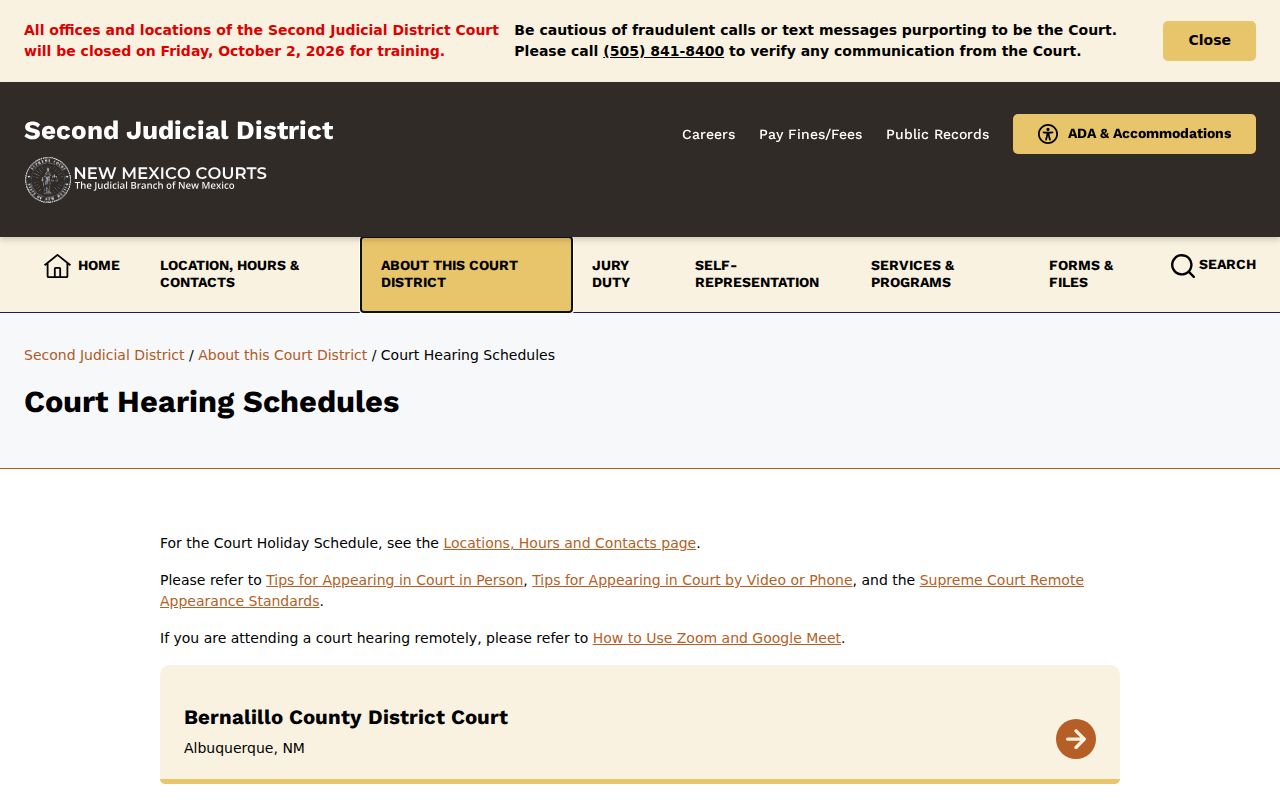
A local calendar page covers one court, not the whole state. For a live hearing date, call the court coordinator or the division clerk. The docket clerk can help you find the filed notice.
Read New Mexico Criminal Case Numbers
A case number tells you which court and which case family you are dealing with. It is not an event code. The First District clerk guidance shows a civil-format example. A Second District records form shows a typical criminal shape. In both, the leading letter marks District Court. A three-digit location code comes next. The category plus year or sequence fills out the rest. The exact pattern depends on the court and the system era.
- D
- The example's prefix identifies District Court. Lower-court identifiers can follow a different structure.
- CR
- A New Mexico criminal case-category example. It does not translate an event or disposition entry.
- Location code
- A three-digit court-location segment appears in the cited examples; the code list is not a complete statewide directory.
- Year and sequence
- The remaining digits help identify the filing period and case sequence. Keep the entire number intact when searching.
The Second District records-request form prints D-202-CR-2024-12345 as a format sample. That number is not a real case. Copy the number straight from your court notice rather than rebuilding it from memory. A category like CR tells you the kind of case, nothing more. It reveals no plea, warrant, bond, or outcome.
Note: New Mexico publishes no statewide dictionary of event abbreviations, so ask the filing court about shorthand you do not recognize.
Which Court Holds Criminal Dockets
New Mexico splits criminal work across court levels. The court named on your citation, complaint, or later notice is the best starting point. Felony trials sit in District Court. Many state-law misdemeanors, DWI matters, and traffic cases start in Magistrate Court. Others begin in the Metropolitan Court. Municipal Courts handle petty misdemeanors, local ordinance cases, traffic, and DWI. Early felony steps, such as the preliminary hearing and first appearance, can happen in a lower court. The District Court case moves ahead after that.
| Court level | Criminal docket role | Record custodian |
|---|---|---|
| District Court | Felony trial docket, juvenile jurisdiction, and many lower-court criminal appeals. | District Court Clerk |
| Magistrate or Metropolitan Court | Many misdemeanors, DWI and traffic matters; felony first appearance or preliminary process. | Magistrate or Metropolitan Court Clerk |
| Municipal Court | Petty misdemeanors and local ordinance, traffic, or DWI matters. | Municipal Court Clerk |
An appeal from a lower court may open a separate District Court case while the first court keeps the original file. Statewide Case Lookup labels these court types, though municipal results stay limited. The New Mexico county directory points you to the local court site, clerk, and docket route for the place that issued the notice.
Get New Mexico Criminal Docket Records
Case Lookup gives case information, not the filed criminal papers. For inspection or a copy, ask the clerk of the court where the case started. Give the case number, the party caption, and the exact document or date when you know it. Local New Mexico offices take requests in person, by phone, email or web form, or by mail. Public terminals and walk-in access vary by court. No statewide rule sets inspection ID or copy turnaround for ordinary records.
A representative Second Judicial District case-records page sends criminal requests to its Criminal Division. It lists viewing and division contacts too. Its base charge is 35 cents per copy page. Certification adds $1.50 per document, and exemplification adds $4.50 per document. Audio on CD costs $4 per disc. Other courts may price or handle things differently, so treat these figures as local examples. Also note that audio is a recording, not a verbatim transcript.
When a public court record is not online, the Judiciary IPRA form routes your request to the court location you select and its custodian. Describe the document with reasonable particularity and fill in the required requester contact fields. Under general IPRA guidance, you get a status response if inspection cannot happen within three business days. A full response comes no later than 15 calendar days. Court-record access rules and local copy procedures may also apply, so check the current schedule before paying.
Note: No uniform copy-processing time applies statewide, and the Administrative Office of the Courts does not hold individual case files.
Public Access and Sealed Criminal Dockets
New Mexico court records are open by default. A rule, statute, or court order can restrict them. Even a public docket may leave out protected details. Access granted to one authorized person does not open the case file to everyone. Match the New Mexico court record rule, criminal-record statutes, and confidentiality provisions against the type of case and its filing date.
Key Rules:
Rule 1-079 NMRA defines court records to include registers and docket entries, allows public inspection subject to protected categories and sealing, and requires masking listed personal identifiers. The approved 2025 text applies to cases pending or filed on or after December 31, 2025; check which text governs an older case.
New Mexico IPRA, NMSA 1978 Sections 14-2-1, 14-2-8, and 14-2-9, provides access to public-body records subject to statutory exceptions. Court files also follow court-specific access rules and orders.
Children's Code Sections 32A-2-32 and 32A-4-33 protect juvenile and abuse-or-neglect information. New Mexico's expungement process concerns criminal records and does not mean every court source is automatically erased.
Treat a New Mexico public result as a court record, and ask the custodian for the signed disposition when you need formal proof. A sealed file may take a court motion or order to open further. The clerk cannot waive that restriction.
What New Mexico Case Lookup Leaves Out
A blank result does not mean the file is gone. It often just marks the edge of New Mexico Case Lookup's reach. The portal shows docket entries. It does not show the documents behind them. Matters filed before 1997 go through a separate Judiciary request route instead. Juvenile criminal cases dropped out of the public search on July 1, 2007. Family Violence Protection Act order-of-protection cases have stayed hidden since July 1, 2008.
Municipal coverage is thin, too. The public set holds only the specified criminal domestic-violence and historical DWI convictions dating from September 1, 1991, not every current city citation. Rule 1-079 lists more confidential categories. Adoption, abuse and neglect, families in need of court-ordered services, and mental-health proceedings all sit outside public view. A judge can also seal an otherwise open case by written order. The clerk masks protected personal identifiers as well. None of this makes every domestic-relations case invisible. Paying for a higher online account tier buys no right to restricted material.
So when nothing comes back, recheck the spelling, court, category, and filing year first. Then call the clerk of the court named on your paperwork. Ask about an older-record request, a local search, or permitted public inspection. The New Mexico county directory lists each court's contact. Treat a missing lookup result as a dead end. It is never proof of any legal outcome.
Note: A case's public visibility depends on its category and orders, so a portal search alone cannot establish that a record was expunged or sealed.